Skip to content

Table of Contents
The jawline is usually the first place patients tell us something has changed. At Layton Aesthetic Plastic Surgery, the earliest signs of facial aging our patients describe along the jawline and neck follow a fairly consistent pattern. Understanding what those changes are, and what is driving each one, makes the conversation with a provider far more productive.
What Do Patients Usually Notice First Along the Jawline and Neck?
The jaw contour blurs before anything else does, and most people spot it in photos or on video calls rather than in a mirror. Mirrors show a familiar, front-facing view. Cameras catch the three-quarter angle, which is exactly where a jawline reveals if it still holds a clean edge.
The five changes patients bring up most often:
- Softening jawline: the clean line from chin to ear starts to blur
- Early jowls: skin and soft tissue settle just past the corners of the mouth
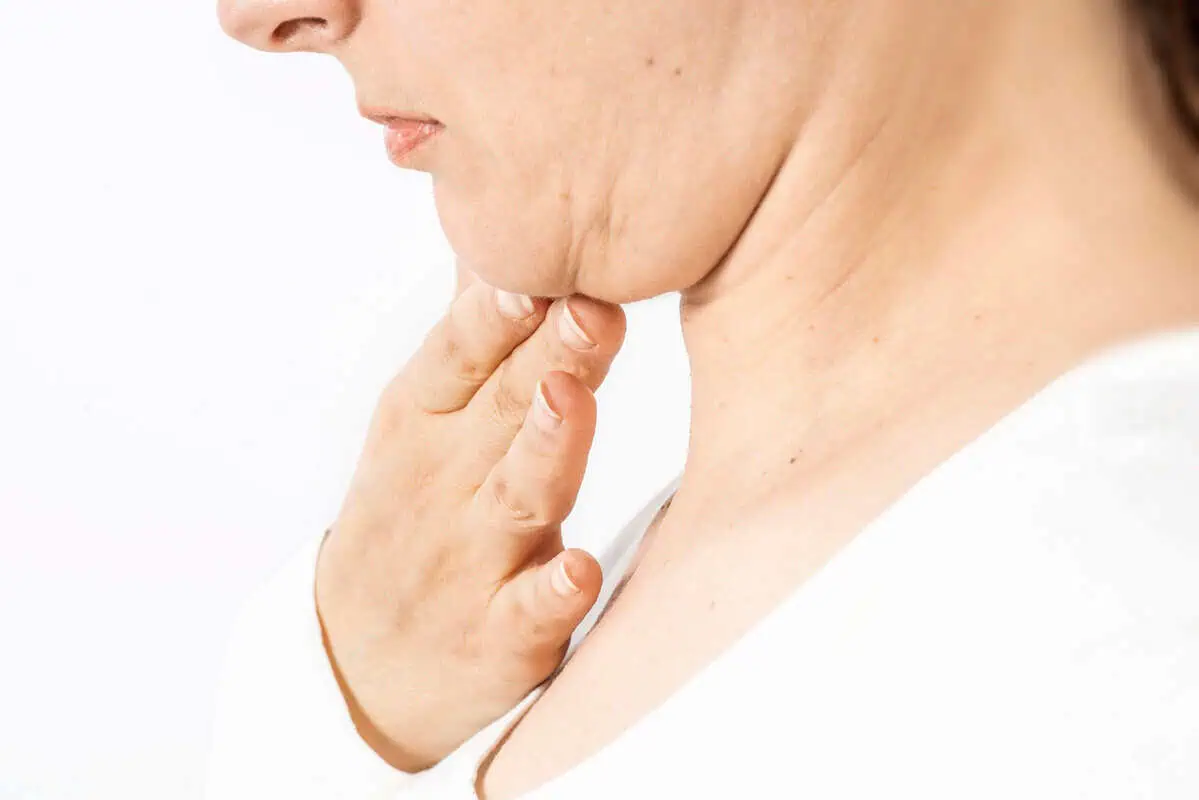
- Submental fullness: a small amount of loose skin or fat under the chin
- Neck bands: thin vertical cords on the front of the neck
- Crepey skin: neck skin that looks thin and finely lined
This area announces itself early for a simple visual reason: a jawline is a line, and the eye registers a broken line much faster than a softened surface. Noticing these changes in your late thirties or forties is common, and it does not mean anything has gone wrong.
What Does Softening Jawline and “Losing Definition” Mean?
A sagging jawline starts as a boundary problem, not a sagging problem. The line running from the chin back toward the ear loses its crispness, and the division between the lower face and the neck becomes less distinct. Patients often describe it as looking heavier without any change on the scale.
You may notice it in small, practical ways. A necklace sits differently, or the angle beneath the jaw looks shallower in overhead lighting.
Softening and sagging are worth separating. Softening is a contour change in which the underlying support narrows, and the surface follows. Sagging is a tissue change in which skin and fat have physically descended. Both bone and fat contribute to that early contour shift, which we cover in more detail later.
Early Jowls: Why Skin Settles Near the Corners of the Mouth
Jowls form when skin and soft tissue drift downward just past the corners of the mouth, creating a small step where the jawline once ran straight. The clinical term for this downward drift is ptosis, which simply means drooping.
Early jowling is most evident when the face is at rest. That is why patients tend to notice it in candid photos rather than in posed ones, since a relaxed face lets the tissue settle into its natural resting position.
One distinction helps here. The jowl runs along the jawline, while the marionette area refers to the vertical lines running from the corners of the mouth downward. They often change together, though treating them as the same thing muddies what a provider is assessing.
Submental Fullness and Neck Bands: The Two Changes Under the Chin
Submental fullness, meaning loose skin or a small pocket of fat beneath the chin, frequently appears at a stable weight, which surprises many patients. The area under the chin holds fat that behaves independently of overall body composition, so neck aging in this zone is not always a weight story.
Neck bands are a different structure entirely. Those thin vertical cords running down the front of the neck come from the platysma, the broad, sheet-like muscle just under the skin of the neck. As that muscle tightens and its edges pull downward, the cords become visible through the skin.
A useful self-observation cue: bands typically become more pronounced during certain expressions, when you tense your jaw, or when the head turns to one side.
Crepey Skin on the Neck and What Sets It Apart
Crepey skin is a change in texture, not in volume or contour. It looks thin and finely lined, like crumpled tissue paper, reflecting the skin’s surface quality rather than the position of anything underneath.
Sun exposure history plays a significant role. The neck is one of the most consistently under-protected areas of the body, since sunscreen routines tend to stop at the jawline, while the neck accumulates years of incidental exposure.
This is also why crepey texture can appear on its own, with no jowling and no jaw softening at all. Texture and laxity generally respond to different approaches, which is worth knowing before any consultation.
Why Do These Changes Happen?
Four processes drive nearly every change described above, and each one connects to something visible. The jawbone gradually loses volume through bone resorption, so the framework holding the contour narrows, producing a softening jawline. Facial fat pads shift downward and shrink at the same time, and that redistribution accounts for the early jowl as well as part of the fullness under the chin.
Collagen and elastin production declines with age, and skin loses its ability to recoil. That is the crepey texture and the general loose neck skin patients describe. Meanwhile, the platysma tightens and pulls downward, producing the vertical banding across the front of the neck.
Early Changes Versus Advanced Laxity: How Do Providers Tell the Difference?
Early changes are largely contour- and texture-based, visible mainly at rest and in specific lighting. More advanced laxity looks different: skin shifts noticeably when the head moves, and deeper creases stay in place regardless of expression.
Our providers assess skin quality, tissue position, and underlying bone support together rather than judging any single sign in isolation. That combined evaluation is what determines the appropriate facial aging treatment options for a given patient.
Facelift surgery addresses significant skin laxity and sagging tissue by lifting and repositioning the skin, removing excess fat, and tightening the underlying muscle, providing a meaningfully different starting point from early softening. Most patients see gradual improvement with either approach, though results vary depending on skin quality, anatomy, and tissue response.
Getting Ahead of the Signs of Facial Aging Starts With a Clear Assessment
Recognizing an early change is useful because the options for softening a jawline are broader than once laxity is well established. An in-person evaluation is the only reliable way to sort out which changes are contour, which are texture, and which involve tissue position.